Prague Castle: tickets and hours 2026
Tickets, opening hours and what no other guide tells you
Tareq Maanan
Founder and guide at ODISEA. I came to Prague more than 10 years ago and never left. Over 5,000 tours later, the city still surprises me. I write these articles for the same reason I guide: so that nobody leaves Prague with the brochure version.
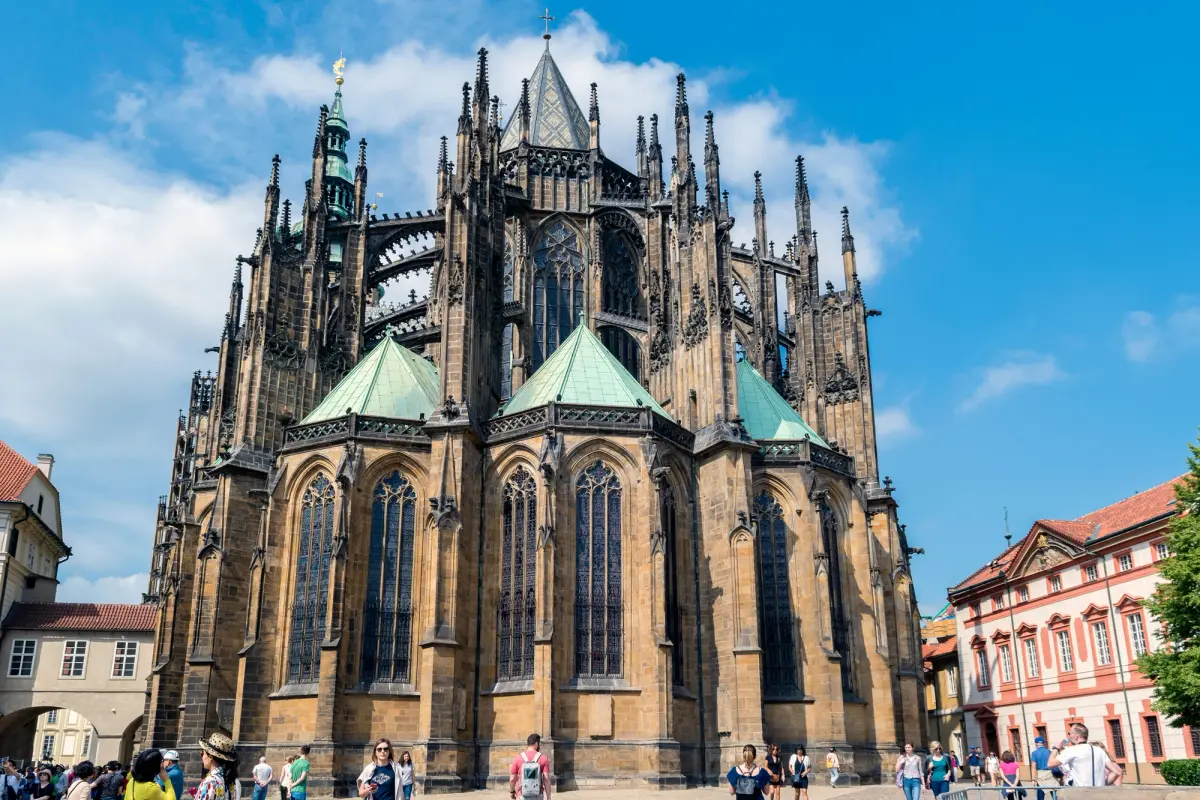
March 9, 2026 · 7 min readThere is a reaction that happens in almost every group we take to Prague Castle. It does not matter where they come from, it does not matter how many monuments they have seen before. When they turn the corner and see the side nave of St. Vitus Cathedral in its entirety for the first time, the moment the Gothic scale of the building hits them all at once, they let out an involuntary "OHHHHHH".
It is not a polite exclamation. It is the sound a brain makes when what it had in mind and what it sees in front of it do not match.
Most travellers arrive at Prague Castle expecting a castle. What they find is a citadel. An entire neighbourhood within walls, with a 600-year-old Gothic cathedral, a palace, a medieval lane, basilicas, gardens and views that have no equivalent in the city. This guide explains what to see, what it costs and how to make the most of it, whether you go on your own or come with ODISEA.
What exactly is Prague Castle?
Prague Castle is the largest inhabited castle complex in the world. It is not a single building; it is a 70,000 m² compound that includes a Gothic cathedral, the Royal Palace, a Romanesque basilica, the Golden Lane, gardens and three interconnected courtyards.
It has been the seat of Czech power for over a thousand years: residence of Bohemian kings, Holy Roman emperors, presidents of the Republic. Today it remains the official seat of the President of the Czech Republic, making it one of the few castles in the world that still serves an active institutional function.
What surprises almost every traveller who takes the tour: the mark left by Maria Theresa of Austria. The empress reformed the compound in the 18th century in the Viennese Baroque style, stuccoed facades, ordered courtyards, an imperial aesthetic that contrasts with the Gothic of the cathedral. Many arrive expecting pure medieval and find instead a layering of styles that is, on its own, a lesson in European history.
What is free and what requires a ticket?
This is the question almost everyone asks before going in, and where most articles get it wrong, because the Castle has three distinct layers of access.
Free (no ticket, no restriction):
- The three courtyards of the compound (1st, 2nd and 3rd courtyard)
- The exterior of St. Vitus Cathedral, including the side nave where the "OHHHHHH" happens
- The Hradčany viewpoint (one of the best views of Prague)
- The South Gardens (seasonal: April-October)
- The institutional entrance of the 1st courtyard (the official facade with the guards)
Paid admission:
- Interior of St. Vitus Cathedral
- Royal Palace
- Golden Lane (Zlatá ulička)
- St. George's Basilica
| Ticket type | Precio |
|---|---|
| Adult | 450 CZK (~18 EUR) |
| Reduced (students, seniors) | 300 CZK (~12 EUR) |
| Family (1 adult + up to 4 children) | 950 CZK (~38 EUR) |
Prices in effect since March 2024. The ticket is valid for 2 days with one entry per building. Source: hrad.cz
Practical tip: The ODISEA free tour covers approximately 80% of the compound without paying for any ticket. What falls outside the free tour are the interiors of the four buildings listed above, which you can visit on your own after the tour if you decide you want to go in.
Prague Castle opening hours
| Season | Compound and courtyards | Interiors (monuments) |
|---|---|---|
| High season (Apr-Oct) | 6:00-22:00 | 9:00–17:00 |
| Low season (Nov-Mar) | 6:00–22:00 | 9:00–16:00 |
The courtyards are accessible from 6:00, but the paid interiors do not open until 9:00. The South Gardens have specific seasonal hours (April to October, usually closing at 18:00 or 19:00).
The compound closes interiors on Christmas Eve. Always check hrad.cz for special events on specific dates; the Castle is an active institutional seat and there may be occasional closures for official events.
How to get to Prague Castle
Option 1, Tram (most comfortable): Line 22 to the Pražský hrad stop. From there, 5 minutes on foot to the 2nd courtyard of the castle. This is the most direct option if you are coming from the centre.
Option 2, Metro + historic stairway: Metro line A to Malostranská. From the stop, walk up the Old Castle Stairway (Staré zámecké schody), about 15 minutes uphill along a cobblestoned lane with views over the rooftops of Malá Strana. More physical, more beautiful.
Option 3, Walking from Charles Bridge (→ ES-15): If you are coming from the Charles Bridge tour, the walk uphill from Malostranské náměstí takes about 20 minutes. Steep, but the route crosses the entire Malá Strana neighbourhood with fantastic views of the Vltava river.
About the security check: There is a security arch at the entrance. During high season there are usually police officers, although they do not always make everyone go through. There is nothing to worry about; it is standard protocol for a presidential seat.
How much time do you need?
| Type of visit | Estimated time |
|---|---|
| Exteriors and courtyards only (the free part) | 1h-1h30 |
| ODISEA free tour (full exterior) | 2h30 |
| Free tour + 2-3 paid interiors | ~4h (if there is no long queue at the Cathedral) |
| Full visit of the entire compound | Half a day or more |
St. Vitus Cathedral is the interior that takes the most time, and the one that generates the longest queue during high season. If you decide to go in, do it at opening (9:00) or late in the afternoon. Mid-morning in July or August, the wait can exceed 45 minutes.
What happens when you see the cathedral from the side
On the Castle tours there is a moment that repeats with almost every group: the instant when travellers turn towards the 3rd courtyard and the side nave of St. Vitus Cathedral appears in its entirety.
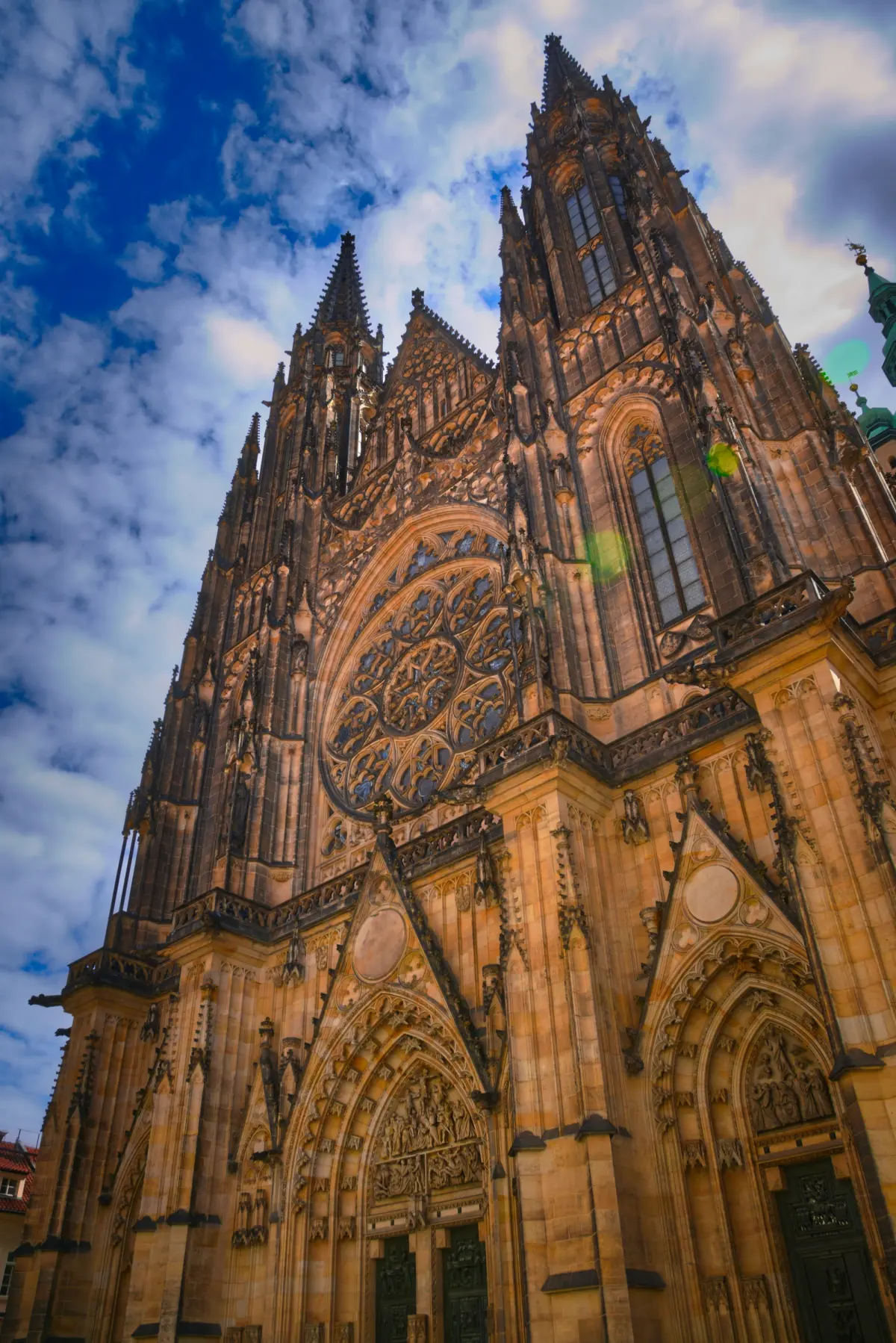
Most arrive having seen photos of the cathedral from the front, from outside the compound or from the air. What no photo prepares you for is the lateral scale, the Gothic flying buttresses, the gargoyles, the spires rising 96 metres, seen from an inner courtyard just a few metres away. No street perspective, no space to step back. The building simply appears, whole, and overwhelms.
The reaction is always the same: a collective, involuntary "OHHHHHH". Nobody decides to do it. It simply happens.
It is the kind of thing you cannot experience the same way on your own, because to reach that exact angle, at the right moment in the route, you need to know exactly where to go. The tour includes it by default.
The question the guide asks upon arriving at the Castle is always the same: "Was this the castle you were expecting?" The answer, almost always, is no.
Visit Prague Castle with ODISEA Tours
The Free Tour Prague Castle and Charles Bridge from ODISEA covers the full exterior route of the compound: Charles Bridge (→ ES-15), the statue of John of Nepomuk, the Malá Strana neighbourhood, St. Nicholas Church, the Castle courtyards, St. Vitus Cathedral from outside, the Hradčany viewpoint, St. George's Basilica, the Golden Lane from outside, the final viewpoint and the summer gardens.
All of that without paying for a ticket. The interiors of the paid monuments fall outside the free tour; if you decide to go in, you do so on your own afterwards. The guide advises you on what is worth entering and what is not, depending on how much time you have.
- Meeting point: entrance to Charles Bridge, Old Town side, under the statue of Charles IV, look for the orange and blue umbrellas. All the information about the free tour in Prague (→ ES-01) is in our definitive guide
- Time: generally 10:00 (confirm when booking)
- Duration: ~2h30
During the tour, the guide also presents the rest of the ODISEA offering, the other city routes and the full-day excursions to the surrounding area. Many travellers who start with the Castle then add an excursion to Kutná Hora (→ ES-06) or Terezín (→ ES-04) to round out the historical experience of the region.
ODISEA Tours has a 5-star rating on Google Reviews. Book at odisea.tours.
What to see in Prague after the castle?
The Castle is the upper part of Prague. What you find on the way down:
- Charles Bridge (→ ES-15), with its 30 Baroque statues, 20 minutes on foot downhill from the compound
- Jewish Quarter (Josefov) (→ ES-03), crossing to the other side of the river, in the Old Town
- Astronomical Clock (→ ES-14), the Old Town Square, about 30 minutes on foot from the Castle
To organise everything into a 2-day itinerary, check our guide to Prague in 2 days.
Frequently asked questions about Prague Castle
Is it free to enter Prague Castle? The exterior compound, courtyards, gardens, viewpoints and exteriors of all buildings, is completely free. The interiors of four monuments (St. Vitus Cathedral, Royal Palace, Golden Lane and St. George's Basilica) require a paid ticket. The price of the combined ticket is 450 CZK (~18 EUR) for adults.
How much time do you need to visit Prague Castle? For the exteriors and courtyards, between 1 hour and 1 hour and a half. If you add the paid interiors, count on about 4 hours in total. The ODISEA free tour covers the full exterior in 2 hours and 30 minutes.
What is the best time to visit Prague Castle? First thing in the morning (from 9:00) for the interiors, with shorter queues. The afternoon has better light for photographing the cathedral from the courtyards. Mid-morning during high season the compound fills up with organised groups.
How to get to Prague Castle from the centre? The most comfortable option is tram 22 to the Pražský hrad stop (5 minutes on foot to the compound). You can also walk up from the Malostranská metro station via the Old Castle Stairway.
Do you need to book tickets for Prague Castle? For the exteriors you do not need anything. For the paid interiors, you can buy at the ticket office or online. During high season (especially July and August), buying online avoids queues at the entrance.
What surprises travellers most about the Castle? Two things: the scale (they expect a castle, they find a 70,000 m² citadel) and the Baroque mark of Maria Theresa of Austria, who remodelled the compound in the 18th century with Viennese imperial aesthetics. The result is a mix of Gothic and Baroque that does not match what most people imagine when they hear "Prague Castle".
Book your place on the Free Tour Prague Castle with ODISEA.