What to Do in Prague in 2 Days: Complete Itinerary (2026)
Day-by-day itinerary with free walking tours in Prague
Tareq Maanan
Founder and guide at ODISEA. I came to Prague more than 10 years ago and never left. Over 5,000 tours later, the city still surprises me. I write these articles for the same reason I guide: so that nobody leaves Prague with the brochure version.
March 10, 2026 · 10 min readTwo days in Prague is not much. It is also enough, if you plan them well.
The city has a clear geographical logic: the Vltava river divides it into two banks, each with its own character. The right bank has the Old Town, the Jewish Quarter and the New Town. The left bank has the Castle, Malá Strana and Charles Bridge linking them together. In two days, at a good pace, you can cover the essentials of both banks and leave having seen 75% of Prague.
This itinerary is ODISEA Tours' recommendation, the one we give travellers when they ask us how to organise their visit. It is not a generic plan: it is the order that works.
Before you start: how to organise the two days
Prague divides naturally into two thematic blocks:
- Day 1, The historic city: Old Town + Jewish Quarter in the morning, Prague Castle + Malá Strana + Charles Bridge in the afternoon.
- Day 2, The living city: New Town in the morning (20th-century Prague, the war, communism, modern architecture), museums and the Clementinum in the afternoon.
The key is the order. Starting with the Old Town on the first day makes sense because it is where you land, geographically central, visually striking, easy to find your bearings. The Castle goes in the afternoon of Day 1 because the afternoon light is the best for seeing it and because arriving after lunch avoids the morning queues.
Day 1: Old Town, Jewish Quarter and Prague Castle
Morning: the Old Town and the Jewish Quarter
Start at the Old Town Square, the gravitational centre of Prague. Before the groups of travellers arrive, the square has a calm that disappears by 10:00. If you can be there at 9:00, all the better.
The first stop: the Astronomical Clock (→ ES-14) (Orloj). Built in 1410, it is the oldest astronomical clock in the world still in active operation. On the hour, the show: the twelve apostles parade past the windows, the figures of the deadly sins move, and the golden cockerel at the top crows and opens its wings to close the performance. It is brief, less than a minute, but the mechanism surrounding it deserves time: the zodiac disc, the agricultural calendar, the dials showing Prague time, Babylonian time and the position of the sun.
From the square, the route continues past the Church of Our Lady before Tyn (the Gothic facade with the two towers dominating the square from the east), Charles University, the oldest in Central Europe, founded by Charles IV in 1348, and the area around Republic Square with the Municipal House (Obecni dum).
The next block is the Jewish Quarter, Josefov (→ ES-03). The historic synagogues (Spanish Synagogue, Old-New Synagogue, Pinkas Synagogue with the 77,297 names of Holocaust victims on its walls) and the Jewish Cemetery are seen from outside on the two-day itinerary; if you want to go inside, set aside extra time or buy the ticket the day before. The Old-New Synagogue (1270) is the oldest functioning synagogue in Europe: even from outside, the contrast between its austere Romanesque style and the neighbouring Baroque synagogues is visible.
The ODISEA free tour for this morning: the Free Tour Old Town and Jewish Quarter covers this entire route with historical context in Spanish. It is the most efficient way to see this part of the city; the guide selects the key points, explains what the signs do not tell you and leaves time for questions. Book your free walking tour.
Lunch
After the morning tour, a break for lunch. The immediate surroundings of the Old Town Square have restaurants for every budget, but as in any tourist area, the further you move from the epicentre, the better the value for money.
If you want to try real Czech food on your first day: Hostinec Sohajka, the Czech restaurant we recommend to our travellers see our guide to traditional Czech food (→ ES-20) for the address and what to order.
Afternoon: Prague Castle, Mala Strana and Charles Bridge
The afternoon of the first day is for the left bank of the Vltava.
Prague Castle is the largest inhabited castle complex in the world, not a single building but a 70,000 m² citadel with a cathedral, palace, basilica, medieval lane and gardens. Visiting the exterior (which includes 80% of the complex) is completely free. The interior of the four main buildings requires a paid ticket.
The moment nobody expects: turning the corner towards the side nave of St Vitus Cathedral and suddenly seeing the Gothic scale of the building. There is a unanimous reaction in every group, an involuntary "OHHHHHH" that the guide already anticipates.
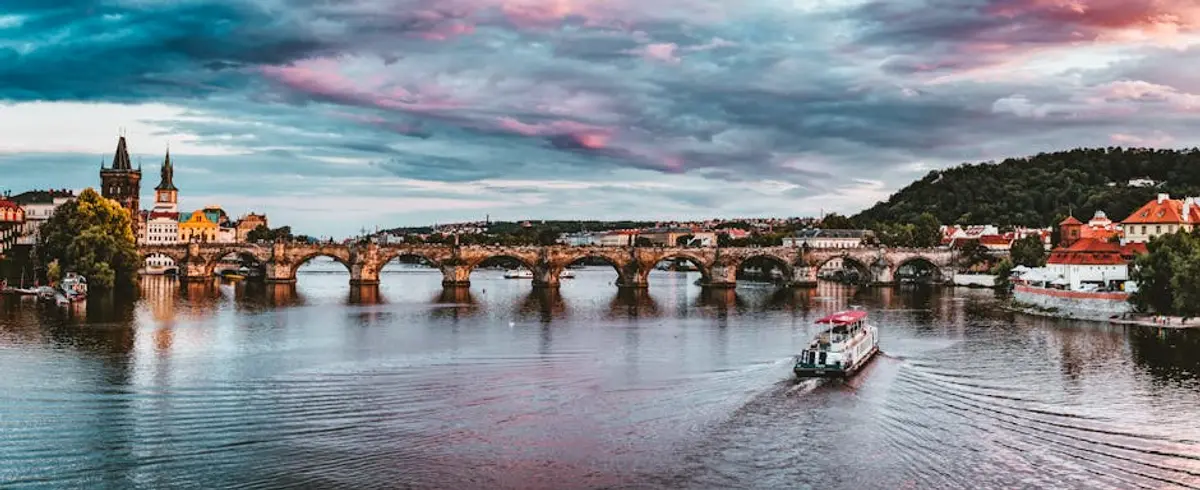
The ODISEA free tour for this afternoon: the Free Tour Prague Castle and Charles Bridge covers the Castle, the Hradcany viewpoints, the descent through Mala Strana and the crossing of Charles Bridge. The bridge, with its 30 Baroque statues of saints and the story of Jan Nepomucky, is one of the great moments of the itinerary. read the full history of Charles Bridge (→ ES-15)
Evening of Day 1: the Petrin lookout
After Charles Bridge, you are at the foot of Petrin hill. Walk up, on foot or by funicular, to the Petrin lookout tower: an iron tower from 1891 with 360° views over Prague at sunset. It is the highest accessible viewpoint in the city centre and produces one of the most complete images of Prague you will see.
Day 2: the New Town and the museums
Morning: 20th-century Prague
The second day starts in the New Town (Nove Mesto), the part of Prague that most tourist articles underestimate. It does not have the density of medieval monuments found in the Old Town, but it has something different: the history of what happened to Prague in the 20th century.
The stops on the route:
The Dancing House (Tancici dum), the Fred Astaire and Ginger Rogers building, designed by Frank Gehry and Vlado Milunic in 1996. One of the finest examples of deconstructivist architecture in Europe. It stands on the bank of the Vltava; the view from the nearby bridge, with the contorted building above the river, is the modern architecture photograph of Prague.
Charles Square (Namesti Karlovo), the largest square in Prague, founded by Charles IV. On the New Town itinerary, it is the central reference point from which you reach the following stops.
The Crypt of Saints Cyril and Methodius. The Orthodox church on Resslova street holds one of the city's most important historical secrets: in its crypt, the paratroopers who carried out Operation Anthropoid in 1942 took refuge, the assassination of SS Obergruppenfuhrer Reinhard Heydrich, the only high-ranking Nazi general eliminated by the Allied resistance during the war. The story of how the soldiers died in that crypt is the one that produces the greatest impact in every group. See the full story in Nazism and Communism in Prague (→ ES-24).
The Vltava river walk. The Vltava from the New Town bank offers a different perspective from the rest of the route: the wide river, the bridges in perspective, Kampa island in the background. It is the moment of decompression after the crypt.
The ODISEA free tour for this morning: the Free Walking Tour New Town: Nazism and Communism covers all these points, the Dancing House, the Lucerna Gallery, the crypt, Charles Square, Wenceslas Square and the Kafka Head, with the narrative thread of Nazism and communism in Prague. It is one of the most intense tours in the catalogue, precisely because of the history it tells.
Afternoon: National Museum and Clementinum
The National Museum (Narodni muzeum), the Neo-Renaissance building that closes Wenceslas Square (→ ES-16) to the south. It reopened after a complete renovation and houses the collections of natural history and the history of Bohemia. If you have the time and energy for a museum in the afternoon, it is the most comprehensive option.
The Clementinum, the second-largest building complex in Prague after the Castle, originally a 16th-century Jesuit college. The Baroque Library of the Clementinum is on the list of the most beautiful libraries in the world. Guided tours of the interior require advance booking. The exterior and courtyards are free to access.
Evening of Day 2: beer garden with views
Prague has two options for local evening leisure that we always recommend:
Riegrovy Sady. A park in the Vinohrady neighbourhood, east of the centre, with a beer garden open in the warmer months. No travellers, just locals, with views of Prague from the hillside of the park. The price difference compared to the terraces in the centre is 50%. It is where Prague locals go when they want a beer with a view.
Letna Park. North of the Old Town, above the river. The Letna beer garden has direct views of the historic centre from the opposite side to the Castle. In summer, one of the most popular meeting spots for Prague residents.
Indicative budget per day
| Item | Range per person |
|---|---|
| Breakfast | 100–200 CZK (~4–8 €) |
| Free tours (voluntary tip) | 200–400 CZK (~8–16 €) |
| Lunch | 200–400 CZK (~8–16 €) |
| Optional tickets (museums, interiors) | 0–600 CZK (~0–24 €) |
| Dinner | 300–600 CZK (~12–24 €) |
| Transport | 80–200 CZK (~3–8 €) |
| Estimated daily total | 800–2.000 CZK (~50–80 €) |
Excluding accommodation. The range depends on how many interiors you visit and the level of restaurants chosen. Full guide to currency and prices in Prague.
Practical tips for two days in Prague
Start early. The Old Town at 9:00 is a different place from 11:00. The Astronomical Clock, Tyn Square, the Jewish Quarter, all of them benefit from the morning.
Use the metro for long distances, walk for short ones. The historic centre is compact; Old Town Square to Charles Bridge is a 10-minute walk. The metro is more useful for getting from the centre to the Castle (line A to Hradcanska) or for returning to your hotel at night. Prague metro guide.
Book the Jewish Quarter ticket in advance. The combined ticket of 600 CZK grants entry to all the synagogues and the cemetery. In high season, the queues are long. Buy online if you can.
Tips are in cash. Free tours work on a voluntary tip at the end; keep some Czech crowns in your pocket. what to carry in cash.
The Castle closes at 17:00 (18:00 in summer). If you are doing the afternoon tour, plan to arrive before 15:00 to leave yourself a margin.
What to add if you have more days
With two days you have 75% of Prague. With more time:
- Day 3, Day trip or deeper Prague: Terezin (→ ES-04) (Nazi transit camp, 6h), Cesky Krumlov (medieval, UNESCO), Kutna Hora (Sedlec Ossuary), or a third day exploring Vysehrad, Vinohrady and local Prague (→ ES-13)
- For 3 full days: What to See in Prague in 3 Days: Complete Itinerary (→ ES-13)
Frequently asked questions about the 2-day Prague itinerary
Is it possible to see Prague in 2 days? Yes. With this itinerary you cover the Old Town, the Jewish Quarter, the Castle, Mala Strana, Charles Bridge and the New Town, 75% of the essentials of Prague. It is not enough to see everything, but it is enough to leave with a complete picture of the city.
How much does it cost to visit Prague in 2 days? The indicative range is 50-80 EUR per person per day (excluding accommodation), depending on how many interiors you visit and the level of restaurants. ODISEA free tours work on a voluntary tip; the guided visit to the Castle exterior and the Jewish Quarter (from outside) is free.
Is it better to start with the Castle or the Old Town? The Old Town. The Castle in the afternoon has better light, fewer queues at the entrance than in the morning, and the geographical logic of the itinerary flows better.
In what order should you do the free tours? Day 1 morning: Free Tour Old Town and Jewish Quarter. Day 1 afternoon: Free Tour Prague Castle and Charles Bridge. Day 2 morning: Free Walking Tour New Town: Nazism and Communism.
What to see in Prague at night? The Petrin lookout (Day 1), the beer garden at Riegrovy Sady or Letna (Day 2). Charles Bridge at night, without travellers, with the statues illuminated, is one of the most peaceful moments in Prague if your hotel is nearby and you can return late.
Can you do Prague in 2 days with children? Yes, with adjustments. The Castle and Charles Bridge work well for all ages. The Jewish Quarter (especially Pinkas Synagogue, with the names of Holocaust victims) requires a certain maturity; for children under 10, it is preferable to see it from outside. The Crypt of Saints Cyril and Methodius (Day 2) is recommended from age 12.
Have 3 days? The article What to See in Prague in 3 Days (→ ES-13) extends this plan with a third day for day trips or the less touristy side of Prague. Only one? Read Prague in one day (→ ES-42).