Kutná Hora day trip from Prague 2026
Sedlec Ossuary, St Barbara's Cathedral and the silver mining history
Tareq Maanan
Founder and guide at ODISEA. I came to Prague more than 10 years ago and never left. Over 5,000 tours later, the city still surprises me. I write these articles for the same reason I guide: so that nobody leaves Prague with the brochure version.
March 10, 2026 · 7 min readWhen you step inside the Sedlec Ossuary for the first time, the silence arrives on its own. You don't need to ask for it.
You see the chandelier hanging from the ceiling, made with every bone in the human body. You see the coats of arms in the corners, also made of bones. You see the columns, the garlands, the pyramids of skulls carefully stacked in the alcoves. And you understand, all at once, that you are inside something that has no equivalent in the world.
Many travellers describe it as stepping into the film Coco, but real. The first reaction is visual: the silence. The second is the question: why? Why does a place like this exist?
The answer to that question turns Kutná Hora into something much bigger than an unusual attraction. This guide explains the history behind the Ossuary, what else you visit on the day trip and why it deserves a full day from Prague.
The history that makes the ossuary make sense
To understand the Sedlec Ossuary, you first need to understand what Kutná Hora was.
In the 13th century, silver was discovered in this corner of Bohemia. Not a little silver — the largest concentration of silver mines in all of Central Europe. Kutná Hora became the second most important city in the Kingdom of Bohemia, after Prague. For two centuries, it minted the empire's currency. The kings of Bohemia temporarily settled here. The wealth that came from the mines financed cathedrals, palaces, religious institutions.
And it also financed something else: population density. The city grew rapidly, with thousands of miners, merchants and workers concentrated in a small space.
Then came the Black Death. After that, the Hussite Wars. In a few decades, tens of thousands of people died in the region. The cemeteries could not cope. The one belonging to the Cistercian monastery of Sedlec, which was already one of the most prestigious in Europe — because the abbot had brought soil from Jerusalem in the 13th century and everyone wanted to be buried there — filled to impossible levels.
The solution was the Ossuary: at the end of the 15th century, a half-blind monk was tasked with gathering the accumulated bones and organising them. What he did was arrange them. Stack them. Create shapes. The result we see today, with more than 40,000 human skeletons, was completed by the woodcarver František Rint in 1870, who transformed the bones into baroque decoration: the chandelier, the coats of arms, the garlands.
The Ossuary is not a place of horror. It is the physical consequence of what happened to this city. When you understand that, the silence changes meaning.
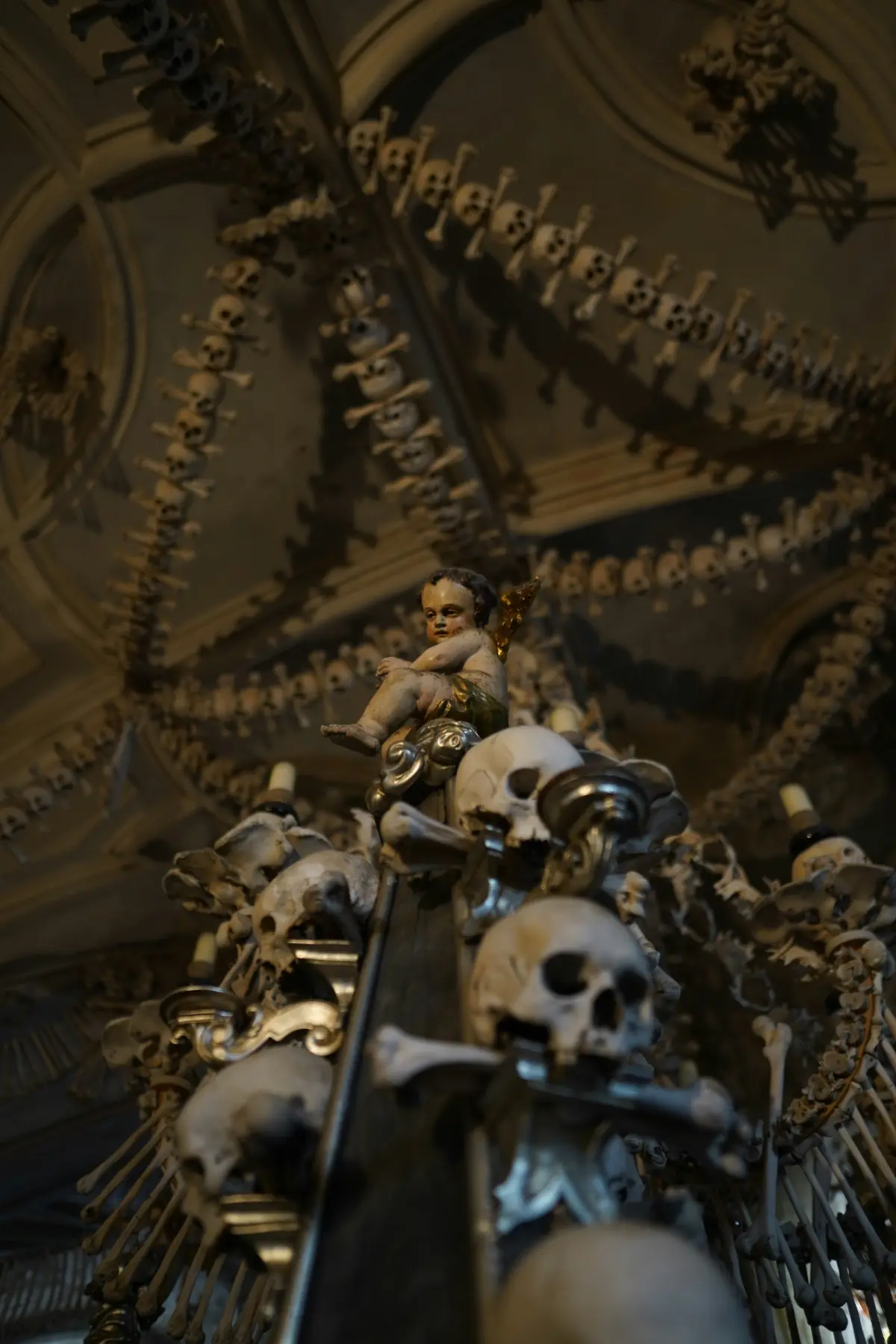
The Sedlec Ossuary: what you see inside
The Sedlec Ossuary, officially the Church of All Saints with the Ossuary, is in the basement of the cemetery church of the Cistercian monastery, about 3 kilometres from the centre of Kutná Hora.
What is inside:
- The central chandelier, made with every bone in the human skeleton, hangs from the centre of the vault
- The four obelisks of skulls and bones in each corner of the chapel
- The heraldic coats of arms of the Schwarzenberg family, built with bones, including a bone raven pecking an eye on the shield
- Rint's signature — the woodcarver signed his work in finger bones in the corner of the wall
- The garlands of skulls decorating the walls
The usual reaction upon entering is silence, followed by gradual observation. Many travellers need a few minutes to orient themselves — the space is small, but what it contains demands that you look at it slowly.
St Barbara's Cathedral: what most blogs underestimate
Most articles about Kutná Hora present the Ossuary as the reason to go and St Barbara's Cathedral as something extra you see on the way. That is a mistake.
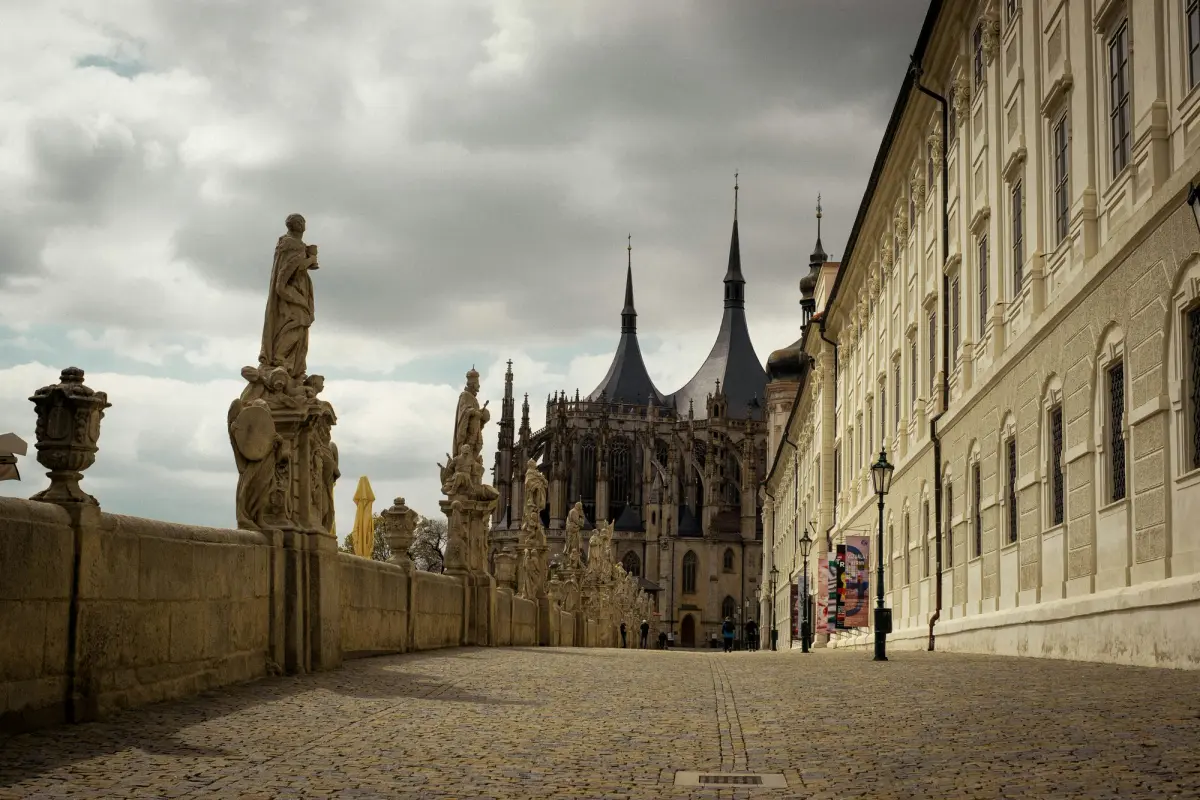
St Barbara's Cathedral is one of the masterpieces of late Gothic architecture in Central Europe. It was built by the mining guilds of Kutná Hora, without royal or ecclesiastical funding, with silver money, as a declaration of economic and cultural independence. The rib vaults, the pinnacles, the stained glass, the flying buttress structure: everything is on a par with the great cathedrals of the continent.
What makes St Barbara's unique is that its interior frescoes document the life of 15th-century miners — scenes of work in the mines, coin-minting procedures, portraits of the guilds. There is no other Gothic building in Europe with this specific iconography of labour.
It is inscribed on the UNESCO World Heritage List (site 732) together with the Historic Town Centre of Kutná Hora.
In traveller ratings, St Barbara's scores as highly as the Ossuary. The difference is that the Ossuary has more noise on the internet.
What do you visit on the day trip?
The ODISEA day trip to Kutná Hora lasts 6 hours and covers the two main stops of the itinerary with tickets included in the price.
Sedlec Ossuary. First stop. The guide introduces the historical context before entering: the silver mines, the epidemics, the Sedlec monastery and the logic that led to the creation of the Ossuary. The visit is more meaningful when you enter already with the framework.
St Barbara's Cathedral and the historic town centre. Second part of the day trip. The tour of the historic centre of Kutná Hora includes the cathedral and the urban context of what was the second richest city in Bohemia. The guide shows the difference between medieval Kutná Hora at its peak and what remained after the decline of the mines and the wars.
What is included in the price?
| What is included | Detail |
|---|---|
| Transport from/to Prague | Private vehicle, return trip |
| Spanish-speaking guide | Throughout the entire itinerary |
| Sedlec Ossuary entrance ticket | Included |
| St Barbara's Cathedral entrance ticket | Included |
| Group size | Maximum 30 people |
Price: €60 per person.
Not included: meals or personal purchases.
Practical information
| Departure point | V Celnici 4, Prague 1 (near the Billa supermarket) – see on Google Maps |
|---|---|
| Departure time | ~8:50 |
| Return time | ~15:00 |
| Total duration | ~6 hours |
| Cancellation | Free up to 48h in advance |
| Accessibility | Please enquire — the Ossuary has stairs to access the basement |
The guide uses the outbound journey (approximately 1 hour from Prague) to explain the history of Kutná Hora: the mines, the wealth, the fall. By the time you arrive at the Ossuary, the group already has the context to understand why it exists. If you have not yet done the free tour in Prague, it is the best starting point to meet the ODISEA team before booking a day trip.
Is it suitable for children?
The most frequently asked question about Kutná Hora.
The Sedlec Ossuary does not contain images of violence or explicit content. What is there are bones organised artistically, which is a visually very different thing from what many people imagine before entering. However, the meaning of the place — 40,000 people — requires context to process.
The recommendation: from 8–9 years old with adult accompaniment who can answer questions, and ideally from 10 years old. Children under 8 can see the space without visual issues, but the historical context does not make much sense to them at that age.
There is no age restriction for entry.
What blogs get wrong about Kutná Hora
The most common error on the internet: selling Kutná Hora as "the city of bones" and reducing the visit to the Ossuary.
The Ossuary is impressive. But you see it in 30–40 minutes. St Barbara's Cathedral has as much value as the Ossuary — different, complementary — and the history of the silver mines is what gives meaning to both sites. Without that context, the Ossuary is a visual curiosity. With it, it is a logical consequence of what happened to this city.
The second error: suggesting that Kutná Hora can be seen "in a few hours" by taking the train from Prague. It can be done logistically, but the time at the complex is very compromised and the historical context is lost. The organised day trip, with the guide who introduces the framework during the journey, produces a completely different experience.
"The ossuary is impressive and the mining culture is very interesting." — Antonio José Planells, August 2025 "The ossuary at the beginning of the itinerary is absolutely incredible." — Daniel, September 2025
Book the day trip
The day trip to Kutná Hora departs on the days shown as available in the calendar. Maximum 30 people per departure.
[→ Book the Kutná Hora day trip, odisea.tours]
Unsure whether to choose Kutná Hora or another day trip? The answer depends on the type of travel you are looking for: Kutná Hora is history + visual curiosity in a compact format (6h). Český Krumlov is scenic and medieval beauty in a full-day format (10h). They are completely different experiences and many travellers do both. Check our guide on what to see near Prague (→ ES-45) to compare all the options.
Frequently asked questions about Kutná Hora
What is the Sedlec Ossuary? The Sedlec Ossuary (Kostnice Sedlec) is an underground chapel decorated with the bones of more than 40,000 people who died during the Black Death and the Hussite Wars of the 14th and 15th centuries. The bones were artistically arranged by the woodcarver František Rint in 1870.
Why does the bone church exist? The cemetery of the Cistercian monastery of Sedlec became the most sought-after in Bohemia (the abbot had brought soil from Jerusalem in the 13th century). After the Black Death and the Hussite Wars, the cemetery became saturated. The accumulated bones were first gathered by a monk and later arranged artistically. The result was the Ossuary as we see it today.
Are the entrance tickets included in the €60 price? Yes. The €60 price includes entrance to the Sedlec Ossuary and St Barbara's Cathedral, as well as transport and a Spanish-speaking guide.
How long does the visit to the Ossuary last? The visit to the Ossuary itself lasts about 30–40 minutes. The total duration of the day trip is 6 hours, including the journey from Prague and the visit to St Barbara's Cathedral.
Is Kutná Hora a World Heritage Site? Yes. The historic town centre of Kutná Hora and St Barbara's Cathedral have been inscribed on the UNESCO World Heritage List (site 732) since 1995.
Can you go to Kutná Hora on your own from Prague? Yes, by train (approximately 1 hour from Prague Main Station). But the organised day trip includes the historical context that transforms the visit — the Ossuary makes much more sense when you enter with the framework of the history of the silver mines, the epidemics and the medieval demographics of the city.
What is the difference between the Ossuary and St Barbara's Cathedral? The Sedlec Ossuary is the underground chapel with bone decoration. St Barbara's Cathedral is a full-scale late Gothic cathedral — 500 years of construction, rib vaults, medieval miner frescoes — considered one of the great works of Central European Gothic. Both are included in the day trip.
What is the meeting point for the day trip? V Celnici 4, Prague 1, near the Billa supermarket. Departure at ~8:50.
If you are interested in the Jewish history of Prague in connection with the Holocaust, our guide to the Jewish Quarter of Prague (→ ES-03) explains what to see in Josefov. And the day trip to Terezín (→ ES-04) takes that history outside the city. And if you are more interested in the general history of the country, be sure to check out our guide to the history of the Czech Republic.