The Vltava river in Prague
Charles Bridge, boat trips, Kampa Island and the best Vltava viewpoints
Tareq Maanan
Founder and guide at ODISEA. I came to Prague more than 10 years ago and never left. Over 5,000 tours later, the city still surprises me. I write these articles for the same reason I guide: so that nobody leaves Prague with the brochure version.
March 10, 2026 · 8 min readYou cannot understand Prague without understanding its river.
The Vltava river, or Moldau as it is known in German, is not a detail in the landscape. It is the axis around which everything revolves. Prague Castle was built on its left bank because from there you could control the crossing. The Old Town grew on the right bank because that is where the merchants arrived. Charles Bridge was built in 1357 to connect those two shores, and since then Prague has never stopped organising itself around the water.
The Vltava is to Prague what the Seine is to Paris or the Danube to Budapest, only here the river passes closer to everything, more quietly, and with less tourism on its banks. I have been living in Prague for more than ten years and have crossed the Vltava thousands of times. This guide is what nobody tells you on Wikipedia: where to see the river the way those of us who live here see it, what history it holds and how to enjoy it.
Vltava or Moldau? The name of the river
This is the first thing Spanish-speaking travellers ask. And it makes sense, because the same river has two completely different names.
In Czech it is called Vltava. It has always been called that. Bedřich Smetana, when he composed his famous symphonic poem in 1874, titled it precisely Vltava. For a Czech, no other name exists.
But in German it is called Moldau, and that German form is the origin of the Spanish name "Moldava." The reason is historical: for centuries, the German-speaking community of Bohemia was the one that transmitted Czech place names to the rest of Europe. Spanish speakers inherited the German version. So when you search for "Moldau river" on Google you are searching for exactly the same thing a Czech searches for as "řeka Vltava."
Some facts that put the river in context:
- 430 kilometres in length, the longest river in the Czech Republic.
- It rises in the Bohemian Forest (Šumava), near the border with Germany and Austria.
- It flows through Prague for approximately 30 kilometres.
- It empties into the Elbe (in Czech, Labe) at the confluence of Mělník, about 50 km north of Prague.
When you see the Vltava from Charles Bridge, you are looking at water that comes from the oldest forests in Central Europe and will end up in the North Sea, passing through Dresden and Hamburg.
History of the Vltava in Prague
Prague exists because of the river. The first Celtic and later Slavic settlements established themselves in this valley because the Vltava offered water, fishing and transport. The Castle hill was chosen in the 9th century because it dominated the crossing — whoever controlled the ford controlled Bohemian trade.
In 1357, Charles IV ordered the construction of Charles Bridge, the most famous crossing over the Vltava. Legend has it that the first stone was laid on 9 July at 5:31 in the morning, a date and time chosen by the court astrologers. The bridge still stands.
The river defined the urban layout that remains today. Right bank (east): Old Town, Josefov, New Town — what travellers call "the centre." Left bank (west): Malá Strana, the Castle, Hradčany, monumental Prague. The Vltava was always the border between two worlds.
The 2002 floods
In the floods of August 2002, the Vltava rose to levels not recorded since the 15th century. Water entered the metro, flooded the basements of the Old Town and destroyed Kampa. If you walk along the river today, you can still see marks on the buildings showing how high the water reached — up to the first floor in some spots.
Since then, Prague has installed flood barriers that deploy when the water level rises. They worked in 2013 and the system remains active.
The islands
The Vltava has several islands within Prague, and each has its own character:
- Kampa, the most famous, separated from Malá Strana by the Čertovka canal (known as "the Venice of Prague"). Kampa Museum, gardens, David Černý's giant baby sculptures.
- Slovanský ostrov (Slavic Island), connected by a bridge to the National Promenade, home to the Žofín Palace and a pedal boat rental point.
- Střelecký ostrov (Shooters' Island), a small, quieter island with a park that few travellers know about. Good views of Charles Bridge.
What to see along the Vltava
If you want to walk the riverbanks on foot, here is a route that works. It is not the one you find in guidebooks; it is the one I do when I have a free afternoon.
Charles Bridge
The obvious starting point. Charles Bridge over the Vltava (→ ES-15), 516 metres, 30 baroque statues, and views of the river that at dawn, without travellers, leave you speechless. At three in the afternoon in summer it is a human motorway.
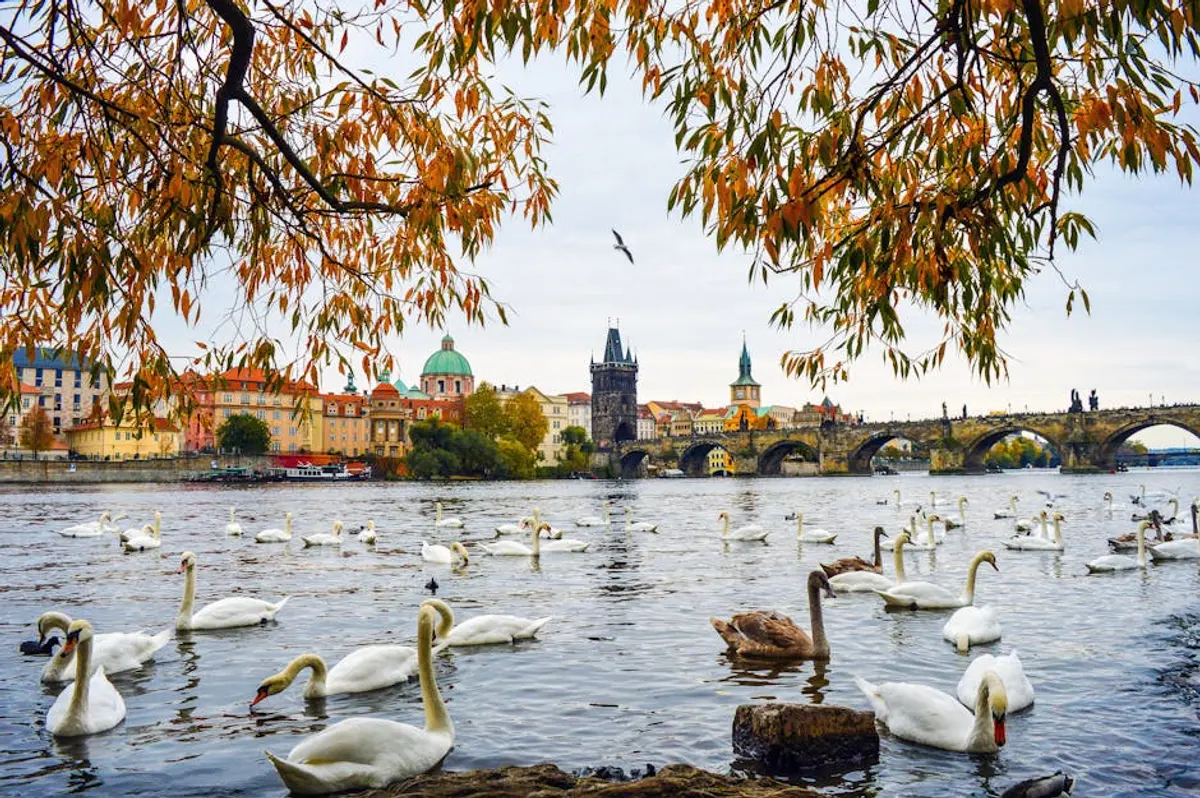
Kampa Island
From the bridge you go directly down to Kampa Island on the Vltava (→ ES-37). The Čertovka canal with its old Grand Prior's Mill, the Kampa Museum, and David Černý's giant baby sculptures looking out at the river. We pass through here on the Castle tour.
Dancing House
Continuing along the right bank southward: the Dancing House on the riverbank. The Gehry and Milunić building that seems to dance above the Vltava — baroque, baroque, baroque, and then suddenly this. The rooftop terrace has river views.
Náplavka
This is where Prague stops being touristy. Náplavka is the embankment along Rašínovo nábřeží, in New Town. On Saturdays there is a farmers' market (8:00–14:00, all year round, 90+ stalls) with local produce, cheeses, cured meats, artisan coffee. In summer, the floating bars open on the river and locals come down at sunset with beers. No trdlo for travellers — this is local.
Vyšehrad
Upriver, the Vyšehrad fortress dominates the Vltava from a cliff. Dramatic views: the river below, Prague in the background, and sunsets that rival those from Letná. Most travellers never make it here. A mistake.
Letná Metronome
On the left bank, climbing up from Čech Bridge, the Letná Metronome occupies the pedestal where the largest statue of Stalin outside the USSR once stood. Today it is a viewpoint with the Vltava's bridges lined up one behind the other. For many locals, the best view in the city.
Boat trips on the Vltava
ODISEA Tours does not offer boat trips. Let me say that upfront so it is clear: what follows are independent recommendations, based on what I tell travellers when they ask me directly.
1-hour sightseeing cruise
The main operators (Prague Boats, Prague Steamboats, Prague River Cruises) offer trips of ~50 minutes for 16–25 EUR per person. From Čech Bridge to Vyšehrad and back. Bar on board, drinks not included. They depart every 30 minutes from 10:00, all year round.
Dinner cruise
Between 40 and 80 EUR per person depending on the boat and menu. They last 2–3 hours, include a buffet or three-course menu, and some have live music. The glass boats (Bohemia Rhapsody, Grand Bohemia) are the most photogenic. From April to October they depart at 18:00 and 20:00; in winter, only at 18:00. For a romantic dinner with views it works well; for the food itself, there are better options on dry land.
Pedal boats
Near Slavic Island (Slovanský ostrov) you can hire pedal boats for 290–400 CZK per hour (12–16 EUR), up to 4 people. April to October only. You need to leave an ID document as deposit.
Kayak and paddleboard
Increasingly popular at Náplavka. Kayaks and paddleboards to navigate through the centre of Prague — the freest and quietest way to see the river.
Smetana and "my homeland": the music of the Vltava
If there is one piece of music that captures a river, it is Vltava by Bedřich Smetana.
Composed in 1874, it forms part of the cycle Má Vlast (My Homeland). Smetana musically traced the river's journey: it begins with two threads of flute representing the two sources of the Vltava in the Bohemian Forest. The streams merge, the river grows, passing through villages, forests, rapids, and finally arrives in Prague with the full orchestra.
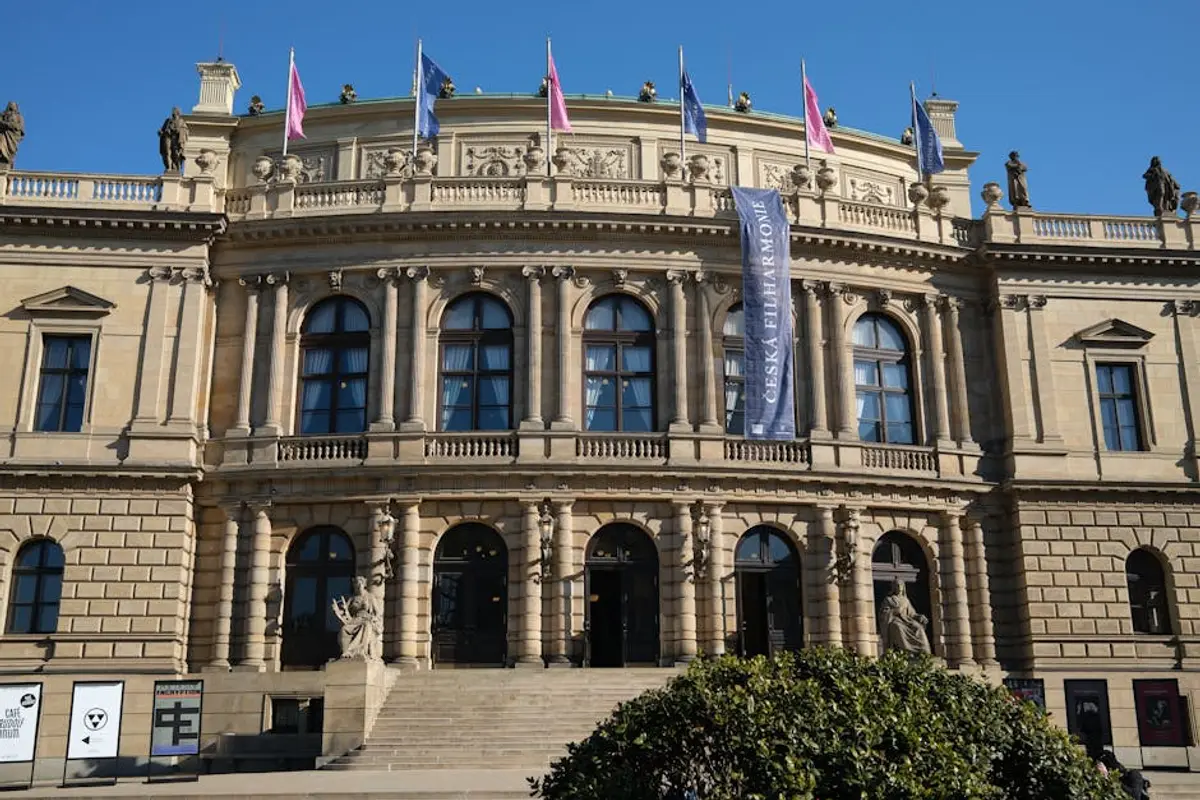
Every 12 May, the anniversary of Smetana's death, the Czech Philharmonic performs Má Vlast at the Rudolfinum. It is the opening event of the Prague Spring Festival. If your dates coincide, getting tickets is difficult but not impossible. Hearing Vltava in Prague, beside the river that inspired it, is unlike anything else.
Experience the Vltava with ODISEA Tours
ODISEA's free tours cross the Vltava on every route. You cannot avoid it — Prague is built upon it.
The Prague Castle tour begins at the entrance to Charles Bridge (Old Town side, beneath the statue of Charles IV, look for the orange and blue umbrella). We cross the bridge, pass through Kampa, and climb up to the Castle with river views that travellers always highlight.
The Old Town tour covers the right bank: Old Town Square, Jewish Quarter, with the river always in the background.
The difference between seeing the Vltava on your own and seeing it with a guide who has been here for ten years is the context. I tell you what happened at each bridge, why the water reached the first floor in 2002, what Charles IV saw when he looked out from the Castle window.
Free tours (tip-based model), ~2.5 hours, book online. Book your free walking tour in Prague.
Frequently asked questions
How much does a boat trip on the Vltava cost?
1-hour sightseeing cruise: 16–25 EUR per person. Dinner cruise: 40–80 EUR. Pedal boats near Slavic Island: 290–400 CZK/hour (12–16 EUR, up to 4 people). ODISEA Tours does not offer cruises — these are independent recommendations.
What is the best viewpoint of the river?
The Letná Metronome — the Vltava's bridges lined up one after the other with the Castle in the background. For something less well known, Riegrovy Sady has river views that few travellers discover. For photos of Charles Bridge: sunrise, before 7:00.
Why is the river called both Vltava and Moldau?
Same river, two names. Vltava is the original Czech name. Moldau is the German form — the German-speaking community of Bohemia transmitted that version to the rest of Europe. Smetana composed his work as Vltava; in German-speaking countries it is known as Die Moldau.
Can you swim in the Vltava?
It is not advisable in central Prague. The currents are stronger than they look, there is boat traffic, and the water quality is not ideal. If you want to swim, locals go to Žluté Lázně (an urban beach upriver) or to reservoirs on the outskirts such as Hostivař or Slapy.
Which bridges cross the Vltava in Prague?
Prague has 18 bridges over the Vltava. The best known: Charles Bridge (pedestrian, 1357), Legion Bridge (opposite the National Theatre), Mánes Bridge (next to the Rudolfinum) and Čech Bridge (access to Letná). The most modern is the Troja bridge (2014).
Where does the Vltava river start?
The Vltava rises in the Bohemian Forest (Šumava), in the south-west of Czechia. It has two sources, Teplá Vltava and Studená Vltava, which merge near Kvilda. It flows 430 km until it empties into the Elbe (Labe) at Mělník, north of Prague. It is the longest river in the country.