Prague Dancing House: How to Visit
Gehry's building by the Vltava: history, rooftop terrace and how to visit
Tareq Maanan
Founder and guide at ODISEA. I came to Prague more than 10 years ago and never left. Over 5,000 tours later, the city still surprises me. I write these articles for the same reason I guide: so that nobody leaves Prague with the brochure version.
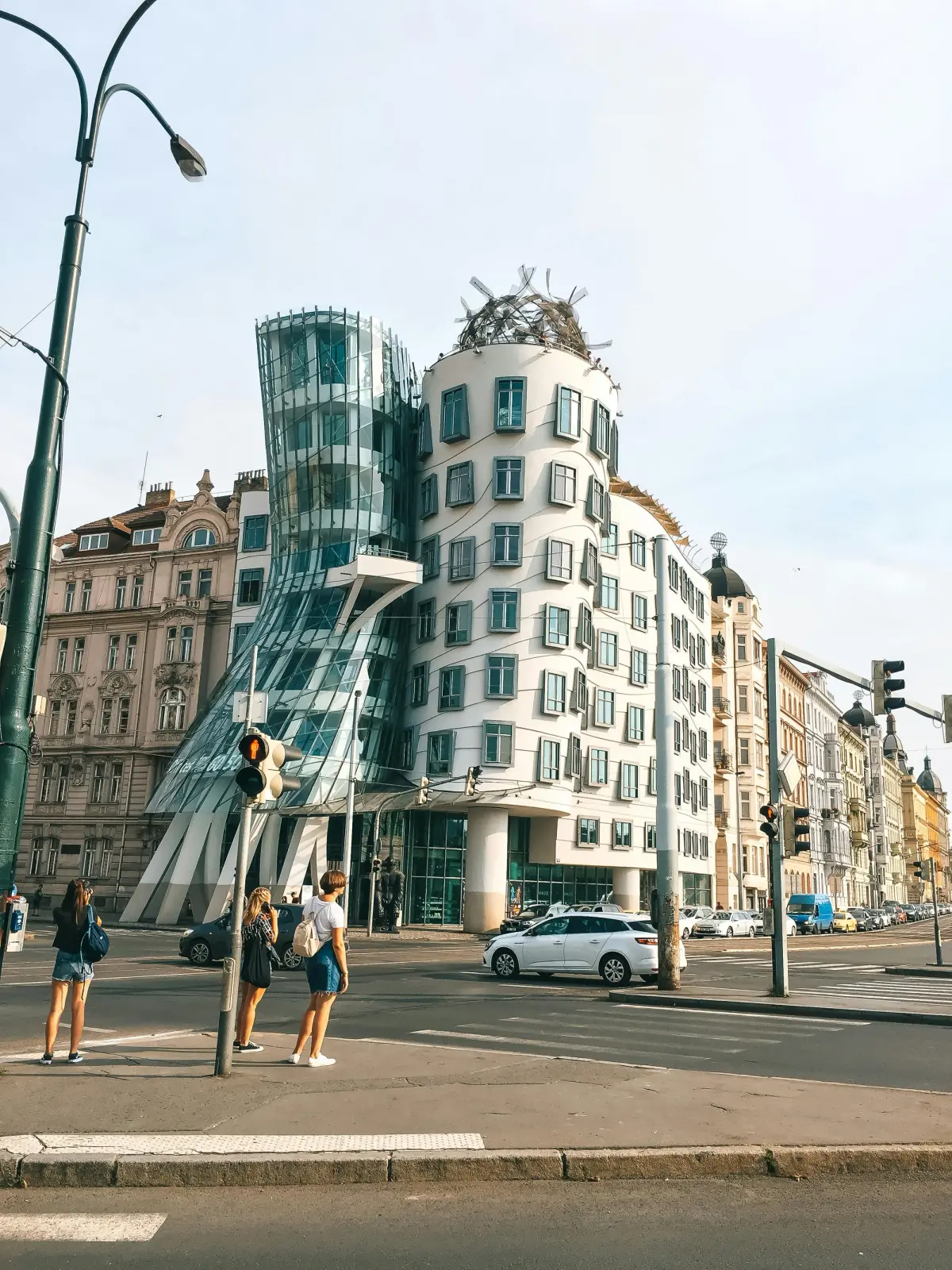
March 10, 2026 · 6 min readThere is a building in Prague that looks like it is moving. Two towers, one rigid, one curved, leaning towards each other like a dance couple frozen mid-spin. Surrounded by perfectly symmetrical baroque and neoclassical facades, the building stands out as if someone had stuck a contemporary sculpture in the middle of a 19th-century neighbourhood.
That is the Dancing House (Tančící dům). And the reaction when it was built in 1996 was exactly what you would imagine: half of Prague hated it.
Today it is one of the most photographed buildings in the city.
On our Free Tour New Town: Nazism and Communism we pass by the Dancing House as part of the route along the Vltava river area. It is one of those moments on the tour where we stop, look up and talk about why this building matters, not just as architecture, but as a symbol of what Prague's transition from communism to democracy meant.
History: from a bombed plot to an icon
The plot where the Dancing House stands was destroyed by American aerial bombing in 1944–1945, in the final days of the Second World War. The rubble remained untouched until the 1960s. For decades, it was an empty gap in the line of buildings along the riverbank, a physical reminder of the war.
The neighbouring land was owned by the family of Václav Havel, the playwright, dissident and future president of the Czech Republic. Havel and the Croatian-Czech architect Vlado Milunić began discussing the project as early as 1986, when Havel was still a dissident persecuted by the communist regime.
After the Velvet Revolution of 1989, the project came to life. Milunić sought an international partner. He first contacted Jean Nouvel, who turned down the commission, considering it too small. Then came Frank Gehry, the Canadian-American architect who would later design the Guggenheim Museum Bilbao.
Gehry and Milunić met in Geneva in 1992 and developed the concept together: two parts, one static and one dynamic. Yin and yang. The rigidity of the past and the fluidity of the future. An architectural metaphor for Czechoslovakia's transition from communism to democracy.
Construction lasted from September 1994 to February 1996. The official inauguration was on 20 June 1996.
The name: Fred and Ginger
Gehry named the building "Ginger and Fred", after Fred Astaire and Ginger Rogers, the Hollywood dance couple. The cylindrical glass tower is "Ginger" (with her curved glass skirt) and the concrete tower is "Fred" (upright, solid, holding his partner).
Gehry later regretted the name. He said he was afraid of importing "American Hollywood kitsch to Prague." The official name ended up being the "Nationale-Nederlanden building" (after the Dutch insurance company that was the first tenant). But "Fred and Ginger" stuck, and today it is mainly used for the restaurant on the seventh floor.
The controversy
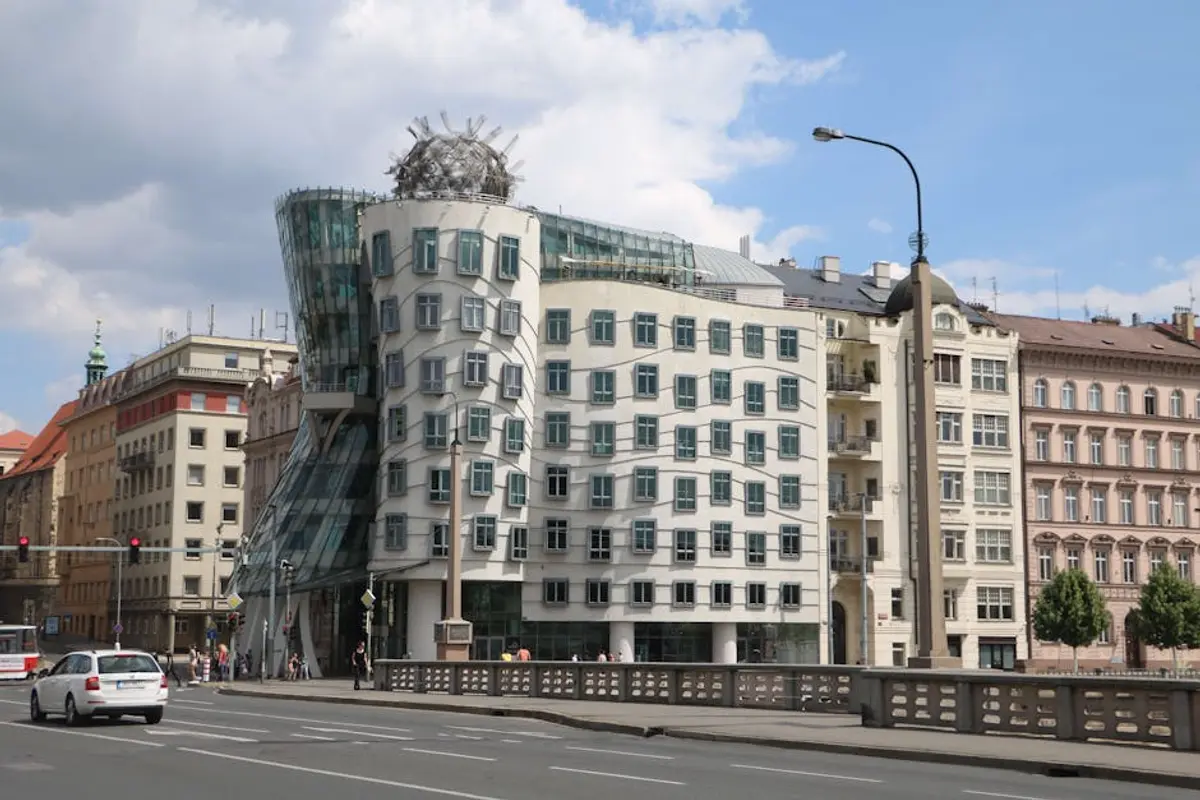
The Dancing House was extremely controversial when it was built. A deconstructivist design, curves, asymmetries, undulating glass, in the middle of 19th-century baroque, gothic and Art Nouveau buildings. For many Prague locals, it was a visual assault. A mockery of the historical heritage.
The design was modified several times during the process due to public pressure, and the final result is less radical than the original plans.
But time did its work. In 1997, the building won Time magazine's design competition. Architekt Magazine named it one of the 5 most important buildings of the 1990s. It appeared on a Czech gold coin worth 2,000 CZK. And today, three decades later, the same Prague locals who criticised it consider it an inseparable part of the city's skyline.
What is inside
The Dancing House is not just a facade. You can go in, and there are several things to see:
Glass bar, the terrace with views
On the top floor of the building, inside the glass dome structure (Ginger's "head"), there is a bar with a panoramic terrace: the Glass Bar.
The views are 360 degrees: Prague Castle, Charles Bridge, the Vltava river and the rooftops of the New Town. At sunset, with the sun dropping behind the Castle, it is one of the best observation points in Prague.
How to access the terrace:
- Buy a drink at the Glass Bar (some drinks cost less than 100 CZK, cheaper than the direct terrace admission)
- Buy a gallery ticket (190 CZK, includes terrace access)
- Pay for terrace-only admission: 100–150 CZK
Glass Bar opening hours: every day 10:00–00:00.
Tip: if you are going up anyway, order a drink instead of paying for terrace admission. It works out cheaper and you get the drink.
Dancing House gallery
On the ground floor and two basement levels there is a contemporary art gallery with exhibitions that rotate throughout the year.
Price: 190 CZK (~8€), includes terrace access. Opening hours: every day 10:00–20:00.
The content varies by season, but the gallery itself occupies around 3,000 m² which also includes a conference centre, cafe and bookshop.
The building inside
Entry to the building is free (doors open 10:00 to 22:00). You can walk into the lobby and go up to the bar or restaurant without paying anything. Payment is only for the gallery or for the terrace if you do not buy a drink.
Daytime vs nighttime
The Dancing House offers two very different experiences depending on the time:
Daytime: the best time for clean architectural photographs. Natural light highlights the glass curves and the contrast with the neighbouring buildings. Early mornings (before 9:00) have the best light without backlighting. If you are interested in architecture, daytime is your moment.
Nighttime: the Dancing House lights up and the reflections of the building on the Vltava river create a completely different image. The glass dome glows against the dark sky. From the Glass Bar terrace, the night views of the illuminated Castle and bridges reflected in the water make the climb worthwhile.
For photos: the best exterior vantage point is the pavement opposite (on the other side of Rašínovo nábřeží) or from the riverbank. From there you capture the entire building in context with the line of neighbouring facades.
Our tour passes through here
The Dancing House is part of the route of the Free Tour New Town: Nazism and Communism. The route passes through the riverside area where the building stands, and it is one of the stops where we talk about post-communist Prague: how the city went from the rigidity of the regime to the cultural and architectural experimentation of the 1990s.
The Dancing House is not just a pretty building, it is a time marker. It represents the moment when Prague decided that its identity was not only in the baroque and the gothic, but also in the capacity to absorb the new without destroying the old. That was controversial in 1996. Today it is a source of pride.
Schedule: at 11:00 (varies by season). Meeting point: in front of ZARA, Na Příkopě 15/583. Duration: ~2h30.
Book Free Tour New Town: Nazism and Communism
For a general overview of all our free tours, see our guide to the free tour in Prague (→ ES-01).
Practical information
Address: Jiráskovo náměstí 1981/6, Prague 2 (Rašínovo nábřeží, riverbank).
How to get there:
- Metro: Karlovo náměstí (Line B), 5 minutes walking
- Tram: lines 1, 5, 7, 17 or 25, nearest stop
- On foot from the centre: 15 minutes from Wenceslas Square (→ ES-16)
Time needed: to see the exterior and take photos: 10–15 minutes. If you go up to the Glass Bar: 30–45 minutes. If you visit the gallery: 1 hour total.
Price summary:
- Exterior: free
- Building entry: free
- Glass Bar: price of a drink
- Gallery + terrace: 190 CZK (~8€)
- Terrace only: 100–150 CZK (~4–6€)
Frequently asked questions
Can you go inside the Dancing House in Prague? Yes. Entry to the building is free (opening hours: 10:00–22:00). You can go up to the Glass Bar on the top floor by buying a drink, or pay 190 CZK for the gallery which includes access to the panoramic terrace with views of the Castle and the river.
Who designed the Dancing House? Frank Gehry (Canadian-American, the same architect behind the Guggenheim in Bilbao) and Vlado Milunić (Croatian-Czech). The project arose from conversations between Milunić and Václav Havel in 1986, before the fall of communism. The interior was designed by Eva Jiřičná.
Why is it called "Fred and Ginger"? After Fred Astaire and Ginger Rogers, the Hollywood dance couple. Gehry saw the two towers as a couple dancing: the curved glass tower is "Ginger" and the straight concrete tower is "Fred." Gehry later distanced himself from the name, but it stuck as a popular reference.
The Dancing House is on the route of the Free Tour New Town: Nazism and Communism (→ ES-24). If you are planning your Prague itinerary, combine it with a walk along the Vltava river (→ ES-47) bank and the Wenceslas Square (→ ES-16) area. It fits perfectly into the 2-day Prague itinerary (→ ES-12).