Easter in Prague 2027: what to see, do and local traditions
Easter markets, green beer and the Czech traditions you won't expect
Tareq Maanan
Founder and guide at ODISEA. I came to Prague more than 10 years ago and never left. Over 5,000 tours later, the city still surprises me. I write these articles for the same reason I guide: so that nobody leaves Prague with the brochure version.
March 9, 2026 · 12 min readIf your idea of Easter week is processions, incense and silence, Prague is going to turn everything you expect upside down.
In Czechia, Easter has almost nothing to do with religion. It is one of the least religious countries in Europe: the vast majority of the population does not declare any faith. Here Easter is a spring festival: open-air markets, pagan traditions centuries old, green beer on a single day of the year and a custom involving willow switches that will leave you speechless.
At ODISEA we have been guiding in Prague since 2017, every Easter included. And this is what we can tell you: it is a good time to come. The worst of winter is over, prices are not yet at summer highs and there are fewer people than in June or July. If you are considering Prague for these dates, read on.
When is Easter in 2027?
The dates change every year. In 2027 Easter falls early, at the end of March:
| Day | Date | Czech name | Public holiday? |
|---|---|---|---|
| Palm Sunday | 21 March | Květná neděle | No |
| Maundy Thursday | 25 March | Zelený čtvrtek | No |
| Good Friday | 26 March | Velký pátek | Yes (since 2016) |
| Holy Saturday | 27 March | Bílá sobota | No |
| Easter Sunday | 28 March | Velikonoční neděle | No (it is a Sunday) |
| Easter Monday | 29 March | Velikonoční pondělí | Yes |
The key fact for planning: Good Friday and Easter Monday are public holidays. That affects shops, transport and some museums. Further down we explain what opens and what closes.
Czech Easter traditions (Velikonoce): what you don't expect
This is what surprises Spanish-speaking travellers most. Every Easter we tell it on our tours and the reaction is always the same: total disbelief.

The pomlázka: the most peculiar tradition in Europe
The pomlázka is a switch braided from young willow branches, between half a metre and two metres long, decorated with coloured ribbons. On Easter Monday morning, boys and men go from house to house and symbolically "whip" girls and women with it. In return they receive decorated eggs (kraslice), sweets or a shot of slivovice, the plum brandy.
The word comes from pomladit, "to rejuvenate". The original idea was pagan: young willow branches pass on the energy of spring, health and youth. Today it survives mainly in villages and within families; in Prague you see it less, and some people criticise it.
For a Spanish-speaking traveller there is no equivalent: nothing like it exists in Spain or Latin America. It is a guaranteed culture shock and one of the stories people most enjoy on our tours.
Kraslice: Czech decorated eggs
Kraslice are not eggs painted with poster paint: they are folk art. Czech craftspeople use techniques such as batik with hot wax, engraving the shell, straw decoration or perforation. And the colours have meaning: red represents new life and health.

You will find them at every Easter market, from simple pieces costing a few euros to handmade works costing dozens. If you want an authentic souvenir of Prague that is not a fridge magnet, a kraslice is what you are after.
Beránek: the lamb-shaped cake
The beránek is a lamb-shaped sponge cake dusted with icing sugar, with raisin eyes and a ribbon round its neck. It is baked on Holy Saturday and eaten on Easter Sunday. You will find it in Prague bakeries over these dates and at the market stalls.
The context: Easter as a spring festival
What unites all these traditions is that they are not religious. Czechia celebrates Easter as the end of winter and the arrival of spring. There are no processions, floats or brotherhoods. There are markets, food, beer and country customs that Czechs keep because they are part of their cultural identity, not their faith.
For someone from Seville, Mexico or Guatemala, where Holy Week is one of the great religious events of the year, Prague offers the opposite version. And that is precisely what makes it interesting.
Easter markets in Prague
The Easter markets (Velikonoční trhy) are the heart of the season. They are smaller and calmer than the famous Christmas markets, but they have their own charm: more intimate and with products you won't see in December.
Dates and locations
They usually open about two weeks before Easter Sunday and close around a week after. In 2027, with Easter on 28 March, they are likely to run from mid-March to the first days of April. The official dates are published early in the year.
The main ones:
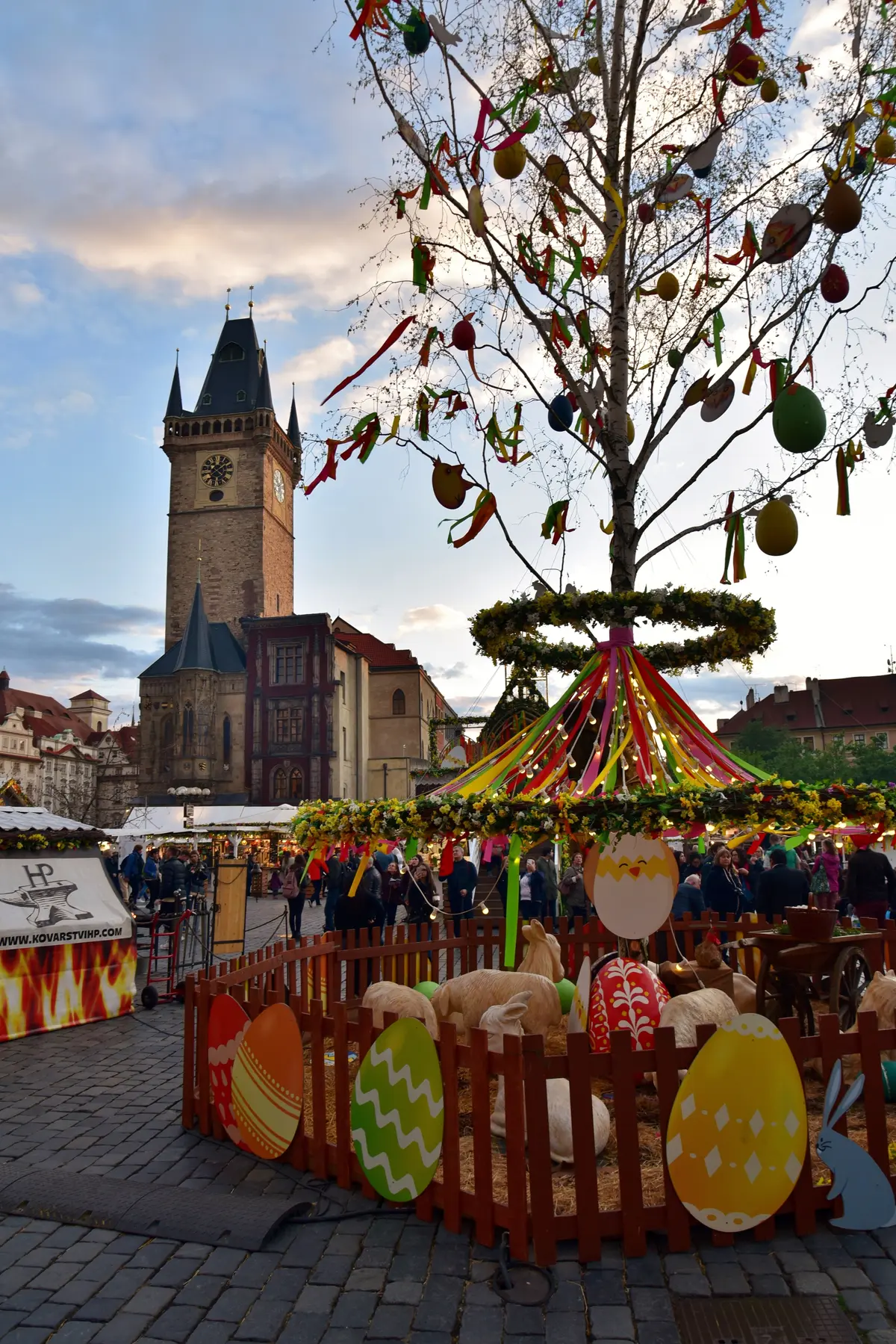
- Old Town Square: the biggest and most beautiful, with an Easter tree decorated with eggs and coloured ribbons
- Wenceslas Square: the second largest, right in the centre
- Neighbourhood markets, smaller and more local, such as those at Náměstí Míru or Anděl
The main market is the one on Old Town Square, with folk performances and the Astronomical Clock next door: the setting is hard to beat. Our Old Town and Jewish Quarter free tour passes through the square, so you can easily combine the two.
What to buy
- Kraslice: handmade decorated eggs (the star souvenir)
- Pomlázka: as a decorative souvenir, not for use
- Honey and beeswax candles: local Czech products
- Wooden crafts: toys, puppets and utensils
What to eat at the markets
- Trdelník: the sweet rolled pastry you will see on every corner of Prague
- Klobása: grilled Czech sausage, hearty and cheap
- Pražská šunka: Prague ham carved off the spit, served with bread
- Medovina: hot mead, the Czech alternative to mulled wine
- Mazanec: sweet Easter bread with raisins and almonds
Green beer: only one day a year
Maundy Thursday is called Zelený čtvrtek, Green Thursday, in Czech. And on that day many breweries and pubs around the country serve zelené pivo, green beer, a modern tradition that has already become a classic.

In 2027, Green Thursday falls on 25 March. If you are in Prague that day, walk into any hospoda (Czech pub) and order one: it is an experience you can only have once a year.
What is the weather like in Prague at Easter?
At the end of March Prague is still cool and unpredictable. Expect highs of around 10-12 °C and lows close to 0 °C. For someone coming from Madrid, Mexico City or Buenos Aires, that is cold. Full stop.
And the weather is fickle: it can rain, turn sunny, hail and turn sunny again in a single day. We have experienced it many times on our tours.
What to pack (what travellers always forget)
- Waterproof windbreaker: non-negotiable. A thick jumper is no use if it rains
- Layers: T-shirt, fleece and jacket. Being able to take clothes off is more useful than one heavy coat
- Thin gloves and a hat: mornings are cold, especially if you take an early tour
- Closed, waterproof shoes: the cobblestones in the centre get wet and slippery. Canvas trainers are not a good idea
- Sun protection: when the spring sun comes out it burns, and nobody expects it
Is everything open at Easter?
It is the question we get asked most at this time of year. Short answer: almost everything is open, but there are important exceptions.
Good Friday (26 March 2027), public holiday
It has been a public holiday since 2016, but large shops may open: Good Friday is not on the list of mandatory closures. In practice, most large shops in the centre open as normal. Banks and public offices do close, and public transport runs a holiday timetable.
Easter Monday (29 March 2027), public holiday
Here things change. By law, shops over 200 m² must close. That includes shopping centres such as Palladium, Chodov or Nový Smíchov: the large shops close, although some restaurants inside may open. Small shops, pharmacies and shops at the airport and stations are exempt. Public transport runs a holiday timetable.
Worth knowing for 2027
- Jewish Museum in Prague: closed every Saturday, including Holy Saturday (27 March). In 2027 Passover falls in late April, so it does not coincide with Easter. If you want to visit the Jewish Quarter, avoid the Saturday
- Castle gardens: they open in early April, so at Easter 2027 they will still be closed. The courtyards, cathedral and viewpoints of Prague Castle can be visited as normal
- Petřín funicular: back in service since September 2026 after its renovation
What runs as normal
- Prague Castle: open every day
- Restaurants and cafés: as normal, especially in tourist areas
- Easter markets: open every day, including Good Friday and Easter Monday
- ODISEA free tours: they also run over Easter
What to see and do beyond the markets
Easter in Prague goes far beyond the markets. With spring, the days get longer and the city starts living outdoors.
Easter concerts
Several Prague churches hold classical concerts over Easter. St Nicholas Church in Malá Strana and the Mirror Chapel in the Clementinum are two of the most common venues.
A 3-day Easter plan
Day 1, Old Town, Jewish Quarter and Easter markets. Our Old Town and Jewish Quarter free tour in the morning, then free time for the markets on Old Town Square and Wenceslas Square. Try the klobása and the medovina. And if it is Maundy Thursday, green beer is compulsory.
Day 2, Malá Strana, Charles Bridge and the Castle. Our Malá Strana and Charles Bridge free tour, which goes inside the Church of the Infant Jesus of Prague, and our Castle, Cathedral and Strahov Viewpoint free tour. Cross Charles Bridge at sunset.
Day 3, a day trip or the New Town. If you have an extra day, get out of Prague: Terezín (6 hours, the most powerful story you will hear), Karlovy Vary (spa town, full day) or Český Krumlov (full day, the most photogenic town in Czechia). If you prefer to stay in Prague, our Nazism and Communism free tour explores the New Town.
For a more detailed itinerary, see our guide on what to do in Prague in 2 days.
How to visit with ODISEA
Our four Spanish-language free tours also run over Easter:
- Old Town and Jewish Quarter: passes the Easter market on Old Town Square. It leaves from the ZARA store at Na Příkopě 15
- Castle, Cathedral and Strahov Viewpoint: it leaves from the statue of Josef Mánes, next to the Rudolfinum
- Malá Strana and Charles Bridge: the baroque quarter and the Infant Jesus of Prague. It leaves from Malostranská metro station
- Nazism and Communism: 20th-century history in the New Town. It leaves from the ZARA store at Na Příkopě 15
They all last about two and a half hours and times are on each tour page. Look for ODISEA's blue umbrella.
Day trips
If you have 3 or 4 days, it is worth booking at least one:
- Terezín: 6 hours, former Nazi ghetto and transit camp. The hardest and most necessary experience
- Karlovy Vary: eight and a half hours, Czechia's most famous spa town
- Kutná Hora: 6 hours, Gothic cathedral and ossuary. A UNESCO World Heritage Site
- Český Krumlov: 10 hours, a UNESCO World Heritage Site. A fairy-tale town in spring
Frequently asked questions
Is it worth going to Prague at Easter?
Yes. Prague at Easter offers something you won't find in Rome, Lisbon or Seville: a completely different version of Easter. Spring markets, Czech pagan traditions, fewer crowds than in summer and more reasonable accommodation prices than in July or August. If you are looking for a cultural rather than religious Easter, Prague is a great choice.
When are the Prague Easter markets in 2027?
They usually open about two weeks before Easter Sunday and close around a week after. In 2027, with Easter on 28 March, they are likely to run from mid-March to the first days of April. The official dates are published early in the year.
What is the Czech pomlázka?
It is a switch braided from young willow branches and decorated with coloured ribbons. On Easter Monday, boys use it to symbolically "whip" girls, a pagan tradition believed to pass on health and youth. In return they receive decorated eggs, sweets or a shot of slivovice.
Is it cold in Prague at Easter?
For a Spanish speaker, yes. At the end of March highs are around 10-12 °C and lows drop close to 0 °C. The wind on Charles Bridge or at the Castle makes it feel colder. Bring layers, a waterproof windbreaker and closed shoes.
Are museums open at Easter?
Most are. Bear in mind that the Jewish Museum closes every Saturday, including Holy Saturday, and that some museums close on Mondays, which may affect Easter Monday: check each museum before you go. Prague Castle opens as normal.
Are there Spanish-language free tours at Easter?
Yes. Our four Spanish-language free tours (Old Town and Jewish Quarter, Castle, Malá Strana and Charles Bridge, and Nazism and Communism) also run over Easter, from their usual meeting points.
You may also like: our guide to the best time to visit Prague, comparing every season, and Prague in April.